

2-eyed seeing
Two-Eyed Seeing is a concept designed by Mi’kmaw Elder Albert Marshall that “learning to see from one eye with the strengths of Indigenous knowledges and ways of knowing, and from the other eye with the strengths of mainstream knowledges and ways of knowing, and to use both these eyes together, for the benefit of all”. This concept promotes the idea that Indigenous and Western knowledge systems are moving parallel from each other, enriching yet not interfering with one another.
In Two-Eyed Seeing, one eye represents Indigenous ecological knowledge while the other eye represents Western Science. For effective locally relevant conservation and management strategies, both Indigenous ecological knowledge and Wester scientific knowledge are essential. “The goal is not to work separately in our areas of expertise, but to instead invite all team members to participate in all aspects of the work and to continuously share and learn together”.
(Credited to Almack et al., 2023)

Co-Production
Co-production of knowledge is a process that brings together Indigenous People’s knowledge systems and modern science to generate new knowledge and understandings of the world that would likely not be achieved through applying only one knowledge system alone. It emphasizes the importance of equity in research relationships, which means there is a space for all knowledge systems to fairly agree on the research process.
For the Arctic indigenous communities, there is a need for more inclusive and equitable research activities. The Arctic research community like WCS Beringia are working on meeting the need for more inclusion and equity as they engage in research alongside community members establishing trust and respect each other cultures and values.
(Credited to Yua et al., 2022)
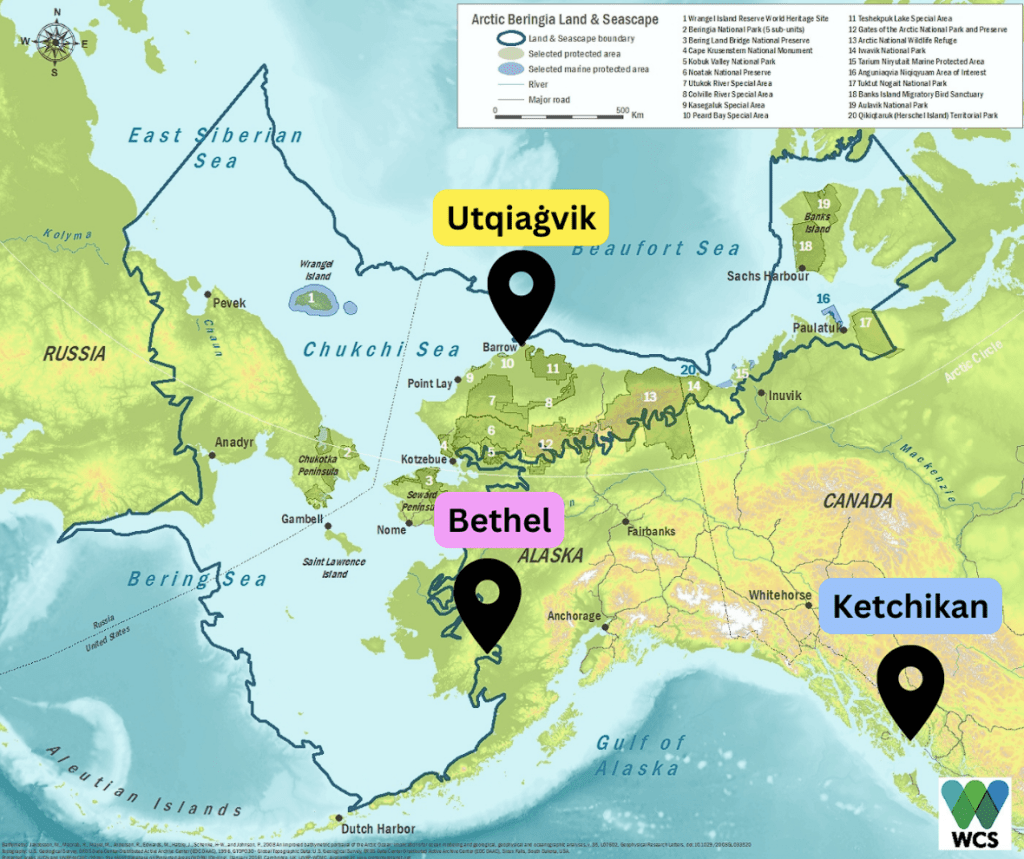

Utqiavik (Utqiaġvik)
Bethel (Mamterilleq)

Ketchikan (Kichx̱áan)
Indigenous Peoples and local communities in the Arctic Beringia region have been self-reliant on wild-harvested food for nutritional needs. The hunting, fishing, and sharing of wildlife within northern communities has been prevalent for their survival. The harvesting of native plants and wildlife for cultural and spiritual needs warrants a more holistic approach to the sustainable use of the environment, to ensure the protection of the region.
 ONE HEALTH | WCS